Lifting keeps wind turbines turning
Without the Lifting Industry, many industries and their supply chains would grind to a halt, writes LEEA CEO, Ross Moloney.
Wind power established new benchmarks in 2025, according to wind energy sector organisation Global Wind Energy Council (GWEC). The 28,395 wind turbines installed across 57 countries hit a record 165 GW – up 40% on 2024, which was the previous record year of new capacity. Wind is now generating power for 138 countries and by the end of 2025 global wind capacity reached 1,299 GW, with a 5.2% growth rate projected for 2026–2030.
This expansion in a truly global sector requires crucial support from the Lifting Industry, where the challenges extend to manufacture, installation, maintenance (over a planned life of around 25 years), inspection and regeneration or decommissioning. Incident-free operation with total reliability and minimal downtime is a fundamental aspect of operational efficiency for wind turbines.
There are specific lifting and lashing equipment requirements in distinct areas: tower production, load securing during transport, tower installation, maintenance, and regeneration. Each of these areas will utilise a wide variety of chains, shackles, slings, clamps, lifting and anchoring points, which must all cope with the full force of an aggressive offshore environment.
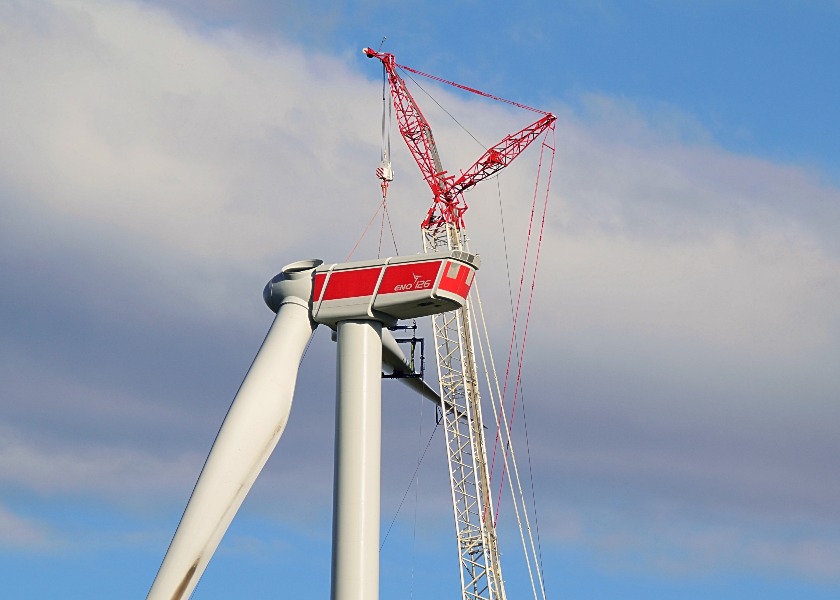
Wind turbines are composed of a nacelle, a hub, carrying typically three blades, and a tower – onshore the latter is usually of concrete but offshore the tower or monopile, whether floating or fixed to the seabed, is generally of steel. A current offshore turbine may have a hub height of 100 metres, and in future could be approaching 150 metres. Blades can be over 60 metres long, and a blade/hub assembly is around 22,000 kg while a complete nacelle with generator may weigh 52 tonnes.
Such large and unwieldy components make installation a highly specialised business. A variety of lifting frames and spreader beams will generally be required and load monitoring by load links or load pin shackles will be critical.
Once installed and operational, maintenance will require the provision of numerous anchorage points, usually in stainless steel for longevity, as well as appropriate PPE for staff. Having a regular maintenance programme is crucial because of the environment in which turbines operate – even for those located onshore the equipment can be subjected to highly corrosive atmospheres. The maintenance programme will identify repairs and help ensure equipment is in good working order. In addition, the equipment needs to be thoroughly examined according to the appropriate regulations. When designing a programme for maintenance, it is vital to take into consideration the risks and the conditions involved as well as the operational environment.
Production of hubs and nacelles requires shackles and slings to present components at an angle during the various processes, while monopile production demands clamping systems in order to manipulate large steel plates and assemblies, all carried out in confined spaces by only one operator.
Service engineers with the right stuff
As the population of offshore wind turbines accelerates, so too will the requirement for service engineers. It takes a particular type of individual, however, because of the environments in which many wind turbines are placed. This may see operations or inspections being carried out at a height of up to 90 metres and often in offshore locations, such as the North Sea, where conditions can be particularly challenging. It’s not just the technical element of the task that’s critical, engineers will also need to be physically fit and have a head for heights and no fear of water.
It generally takes two service engineers per turbine, who in good conditions can inspect one or two turbines a day. Items to be inspected include service ladders, lifelines, hoists, davits, jib cranes and a whole range of lifting and man-riding anchor points. The duration of each inspection can vary considerably depending on the weather, the condition of the assets and their age.
Operators and owners of the turbines, as well as the maintenance companies, all expect high service levels. But with more companies entering this sector, there is a widely held concern that business may be won through offering cheaper prices, which in turn will reduce the quality and standard of work required. By cutting costs it may tempt some companies to reduce their service levels to a mere box ticking or asset checking exercise, which never ends well.
Upping safety
Upping safety is a key issue for installation, maintenance and inspection in the wind sector. At present, common deficiencies range from the lack of hi-vis clothing to unbalanced lifts that can sometimes lead to the total loss of the load. The consequences of this extend to not only wasted fuel because lifts had to be aborted but, even more importantly, the health and safety implications that may ensue.
It is estimated that over 90% of all accidents are as a direct result of human error, with major contributors being carelessness, ignorance and incompetence. Part of striving for operational excellence is having a lift plan for every lift, whether it be a highly complex lift or the everyday low-complexity routine variety.
Safety must be paramount in any lifting operation. Individual or corporate ignorance can result in severe consequences: accidents, visits from health and safety inspectors, compensation payouts and possibly even prosecution and punishment. It is absolutely critical that this is clearly understood, not only by those who operate the equipment or supervise lifts, but also by those who hold responsibility at managerial and director level.
Failures are entirely avoidable provided everyone in the chain of responsibility performs their role professionally and understands that lifting equipment as well as the turbines themselves have to be looked after. Regular inspection of lifting equipment must be a focus for planned maintenance programmes.
It is vital that Duty Holders associated with these operations are aware of all their legal responsibilities. The Duty Holder is the person who is responsible for the lifting equipment in service within their operation – usually an employer or self-employed person, facility owner, person in charge of the equipment or a hire company.
If they do not possess the necessary skills or knowledge required, they may delegate to qualified personnel or organisations. This does not absolve them of responsibility; it simply changes the nature of their accountability.
The Duty Holder must ensure that those undertaking the tasks are suitably qualified, experienced, trained and equipped – in short, competent for their task. This means ensuring that employees and sub-contractors undertaking the task are assessed, properly trained and provided with the necessary equipment for their role. For external organisations, the Duty Holder must have procedures in place for vetting their competency.
Competency required
Wherever competency is lacking, serious consequences are more likely to result, which is critical when it comes to lifting tasks that, more often than not, involve clear health and safety risks.
Competency combines practical knowledge and experience with technical know-how. It is about a person understanding what they have to do to perform a task, receiving the proper training to ensure they perform it correctly and that they understand the limitations of, and safe practices for, the task.
To ensure best practice is conducted by its members, LEEA (Lifting Equipment Engineers Association) offers a range of training courses on the inspection and examination of lifting equipment, with delivery methods to suit the needs of a trainee/ employer. LEEA’s vision is one of lifting and height safety industries that have eliminated accidents, injuries and fatalities. It also has a mission to educate, influence and enable so that best practice is everyday action. Our understanding is that there is a direct correlation between training and amended, ie, safer behaviour. Safety in lifting operations ultimately comes down to people, their knowledge, their skills and their competency.
We wish to remind end users how important it is to use high quality suppliers who utilise competence, experience and high-quality training, and who routinely develop innovative solutions. Seek out the LEEA logo because it provides assurance of safe and expert practice when it comes to lifting equipment and services such as maintenance and inspection. A LEEA member will be recognised globally as being competent having undergone a rigorous assessment process tailored to the circumstances of different industries. This ensures they uphold LEEA’s ‘gold standard’ and provide customers with the assurance of excellence because this, as well as the wind, is what will keep turbines turning.
For further information on LEEA, visit: www.leeaint.com.