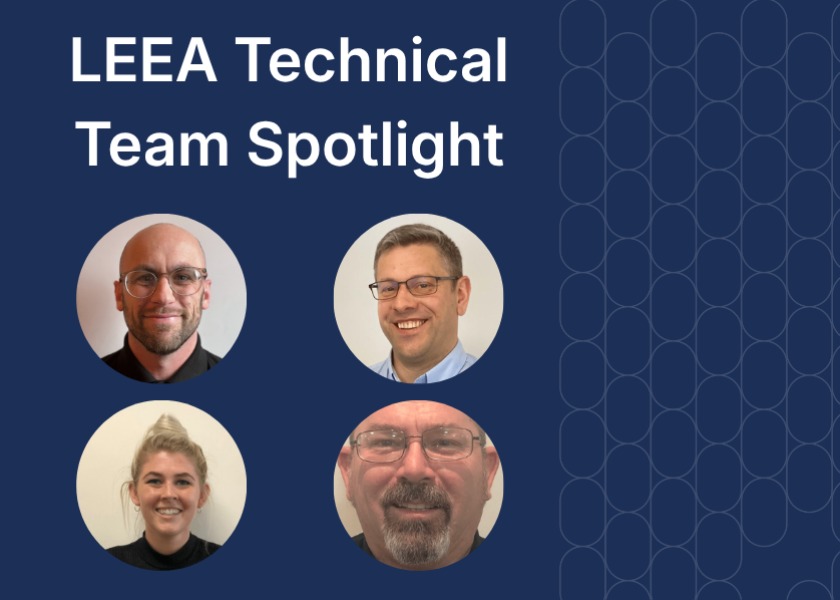
LEEA Technical Team Spotlight
Technical Team Questions
Behind every safe lift, every compliant certification, and every well-informed decision made across the lifting industry, there's a team working quietly to make it all possible.
In this feature, we sit down with the people behind the knowledge: what drew them to this specialist field, the challenges they help members navigate, and what it takes to stay at the forefront of technical expertise in an industry where getting it right really matters.
How is the technical landscape of the lifting industry changing, and how is the team preparing members for what's ahead?
The technical landscape of the lifting industry is advancing rapidly as equipment integrates intelligent control systems, enhanced sensing, automation, and more complex structural and mechanical designs. These developments introduce new risk profiles and failure modes, and because lifting operations remain inherently high‑risk, the industry cannot rely on generic or universal solutions. Continuous evolution is essential to maintain safety, reliability, and compliance.
LEEA is directly shaping that evolution. Our technical team is actively involved in legislative and standards steering groups worldwide, influencing both regulatory direction and product‑specific safety requirements. Through this engagement, we ensure that new and revised standards reflect the LEEA philosophy: risk‑based design, robust engineering principles, competent operation, and inspection‑led assurance. This allows us to embed state‑of‑the‑art thinking into the very foundations of equipment safety, from design and manufacture through to installation, operation, and lifecycle management.
Our influence extends far beyond inspection and examination. We contribute to the development of product safety requirements, performance criteria, structural integrity expectations, and system‑level safety architectures. By doing so, we help shape how lifting equipment is conceived, engineered, and validated, ensuring that global standards evolve in line with modern technologies and real‑world operational challenges.
At the same time, we prepare members for what lies ahead by analysing emerging technologies, assessing their implications for product design, system safety, and operational risk, and updating guidance, training, and competency frameworks accordingly. This ensures members remain equipped to operate safely and confidently as the industry transitions into more advanced, interconnected, and data‑rich lifting environments.
Can you tell us about your background and what led you to become a technical expert in the lifting industry?
My career began with a clear ambition to become a mechanical engineer, driven by a deep interest in machine behaviour, structural mechanics, and how engineered systems respond under load. That led me into the design of bespoke cranes and lifting accessories, where I gained first‑hand experience of the complexities involved in creating safe, efficient lifting solutions.
During this period, it became evident that several design codes contained significant gaps, many resulted in heavily over‑engineered structures, while others lacked modern safety technologies or did not fully reflect real‑world fatigue behaviour. To address this, I completed a master’s degree focused on the fatigue strength of crane structures, using my dissertation to propose improvements to product safety codes and enhance design efficiency without compromising integrity.
My work on standards brought me into closer contact with LEEA, and ultimately into the technical team. This allowed me to broaden my focus from individual product design to the wider industry challenges faced by manufacturers, inspectors, and end users. Working directly with members, I began identifying systemic issues, shaping technical resolutions, and contributing to the development of safer, more coherent industry practices.
Today, I continue this work with a team of highly specialised technical experts. Together, we influence product and equipment safety requirements, contribute to global standards development, and support legislative steering groups with a clear, risk‑based, state‑of‑the‑art philosophy. Through this sustained effort, we have become recognised internationally as authorities in lifting equipment safety, design, and technical governance.
What does a typical day look like for someone providing technical guidance to members around the world?
A typical day in the technical team is anything but routine. Members contact us from all over the world with challenges that are often entirely new — not because they lack competence, but because the lifting industry regularly presents scenarios for which no documented solution yet exists. The diversity of equipment, environments, load behaviours, and regulatory frameworks means novel problems arise constantly.
Our role is to evaluate each issue from first principles. Using our collective engineering knowledge, analytical tools, and access to global standards and legislative frameworks, we assess the technical problem, identify the underlying risks, and provide immediate, evidence‑based guidance. This allows us to support a highly varied industry with on‑the‑spot solutions that are technically robust and aligned with state‑of‑the‑art practice.
However, some challenges extend beyond current industry capability or existing standards. In those cases, we coordinate wider expertise, drawing on specialist engineers, manufacturers, notified bodies, and international authorities, to develop new solutions and establish acceptable industry practice where none previously existed. This is how gaps in guidance, standards, and product safety requirements are identified and closed.
In short, every day is a learning day because every day advances the industry. Each enquiry helps us refine our understanding, strengthen global guidance, and ensure that LEEA members benefit from the most current, technically sound advice available anywhere in the world.
Can you share a moment when you knew your advice had helped prevent an incident or protect people on the ground?
LEEA’s technical advice service is free, confidential, and available to members across the entire lifecycle of lifting equipment, from design and manufacture through supply, installation, inspection, maintenance, and use. Every one of those stages is safety‑critical, and we routinely deal with enquiries where proceeding without guidance could have led to a dangerous occurrence or even a catastrophic failure.
There have been many occasions where our intervention has directly prevented an incident. These include identifying unsafe rigging configurations, correcting incorrect installations, challenging inadequate design assumptions, advising on unsuitable equipment selection, and providing rejection criteria for defects that members were unsure how to interpret. In several cases, the member was facing a scenario with no documented solution, and our technical assessment provided the clarity needed to stop an unsafe operation before it began.
Because of this, we reinforce a simple principle across the industry: if in doubt, ask. The lifting environment is too complex, too variable, and too high‑risk for assumptions or guesswork. A short conversation with the technical team can prevent a major incident, protect people on the ground, and ensure operations proceed safely and in line with state‑of‑the‑art practice.
These moments, where advice directly prevents harm, are a core part of why the technical service exists. They demonstrate the value of giving members immediate access to expert, evidence‑based guidance that keeps lifting operations safe and prevents incidents before they occur.
How does the team's work contribute to raising standards across the lifting industry as a whole?
The technical advice service acts as LEEA’s eyes and ears across the global lifting industry. On the surface, members benefit from tailored, case‑specific solutions to their immediate problems, but the wider value is far greater. Every enquiry we receive becomes part of a much larger technical picture.
By logging, categorising, and analysing the issues raised by members, we can identify common trends, recurring failure modes, and emerging risks. When multiple enquiries relate to a particular product type, we can isolate the underlying problem and address it directly within the relevant product safety code. Likewise, when we see repeated issues in a specific lifting operation, we use that data to strengthen the appropriate Code of Practice and improve industry‑wide guidance.
Occasionally, the patterns we observe highlight gaps or flaws in existing safety legislation. In those cases, we use the evidence gathered from member enquiries to engage with regulators and enforcement authorities, ensuring that real‑world industry challenges are reflected in future legislative improvements.
Not every issue can be resolved through standards or legislation, and when that happens, we develop solutions through LEEA’s own published guidance — updating existing documents or creating new ones where necessary. This ensures that members always have access to state‑of‑the‑art advice, even in areas where formal standards have not yet caught up.
Through this continuous feedback loop, member enquiries, technical analysis, standards development, legislative engagement, and guidance creation, the technical team plays a central role in raising safety, consistency, and competency across the entire lifting industry.
Can you describe a time when your input helped shape or improve a standard, guidance document, or industry practice?
There isn’t a single defining moment, because shaping and improving standards, guidance, and industry practice is what the Technical Services branch has been doing continuously and deliberately since its inception. It is our core purpose. For more than 40 years, LEEA has taken leading roles in the development of lifting‑equipment standards, safety legislation, and technical guidance, ensuring that the industry evolves in line with modern engineering knowledge and operational realities.
Since we first became active in standardisation, we have contributed to the development or improvement of more than 300 lifting‑equipment‑specific safety standards worldwide. These standards are not static; they are continuously reviewed against member feedback, emerging technologies, changes in legislation, and advances in engineering science. When gaps, ambiguities, or outdated assumptions are identified, we work within the relevant committees to amend or revise the documents, so they remain aligned with state‑of‑the‑art practice.
At present, we are actively involved in approximately 80 live standards under review, each representing an opportunity to refine product safety requirements, strengthen operational guidance, and improve global consistency. This ongoing work ensures that the lifting industry does not simply react to change — it progresses through structured, evidence‑based improvement driven by LEEA’s technical leadership.
What's the most rewarding part of helping a member work through a difficult technical challenge?
For me, the most rewarding part of helping a member through a difficult technical challenge is the feedback and genuine gratitude we receive. Sometimes it’s as simple as confirming their thinking and giving them the confidence to proceed. Other times it’s alleviating stress, taking a weight off their shoulders, or preventing them from unknowingly stepping into a serious safety issue.
Knowing that our input has made a tangible difference — whether by improving clarity, preventing an unsafe lift, or protecting people on the ground — is a powerful motivator. It reinforces why the technical service exists and why we work so hard to maintain state‑of‑the‑art guidance for the industry.
I’m proud to be part of a team that makes a real, measurable difference to lifting safety worldwide. That sense of impact is what drives us every day.
How do you stay ahead of emerging risks and technologies so members receive advice that's not just correct, but current?
We stay ahead of emerging risks and technologies because we operate at the very centre of global lifting‑equipment activity. From the top down, we are directly involved in legislative initiatives, standards development, and international steering groups, giving us early visibility of regulatory change, new safety philosophies, and evolving product‑design requirements.
From the bottom up, we receive constant feedback from members who are encountering new technologies, novel lifting scenarios, and previously undocumented challenges. This real‑world insight is invaluable: it shows us how equipment behaves in practice, where gaps exist in current guidance, and where new risks are beginning to emerge.
Together, these streams form a continuous information cycle. We analyse, compare, and feed this intelligence back into standards work, guidance development, and member support. Because we are engaged at every stage, legislation, standardisation, industry practice, and frontline problem‑solving, the advice we provide is not only technically correct, but fully aligned with current and emerging state‑of‑the‑art practice.
This is how we ensure members receive guidance that is accurate, relevant, and future‑proof.
For more information on our technical team, click here.
Help us to shape the future of lifting
We're always keen to welcome members to our subcommittees, giving you the chance to actively shape our ongoing commitment to serving members well. Getting involved means helping us deliver a service that truly reflects what members need and keeping LEEA relevant and effective as the industry continues to evolve.
Interested in joining our governance team? contact: Ross.Moloney@Leeaint.com